I’ve loved fairy tales all my life. I used to be one-sided in my judgments, rooting for the protagonist while celebrating the villain’s inevitable destruction because, in fairy tales, the good guys always win — or do they? I made no room for empathy, just: “Off with their heads!” As if everything is black and white, or as if fictional characters aren’t as complex as we are.
More than ever, audiences are open to examining what drives harmful behavior — and to asking why. Why did Maleficent crash a christening and curse a baby? Why did Cinderella’s stepmother hate her so much that she forced her to sleep in the attic? And why did the Beast act so, well, beastly?
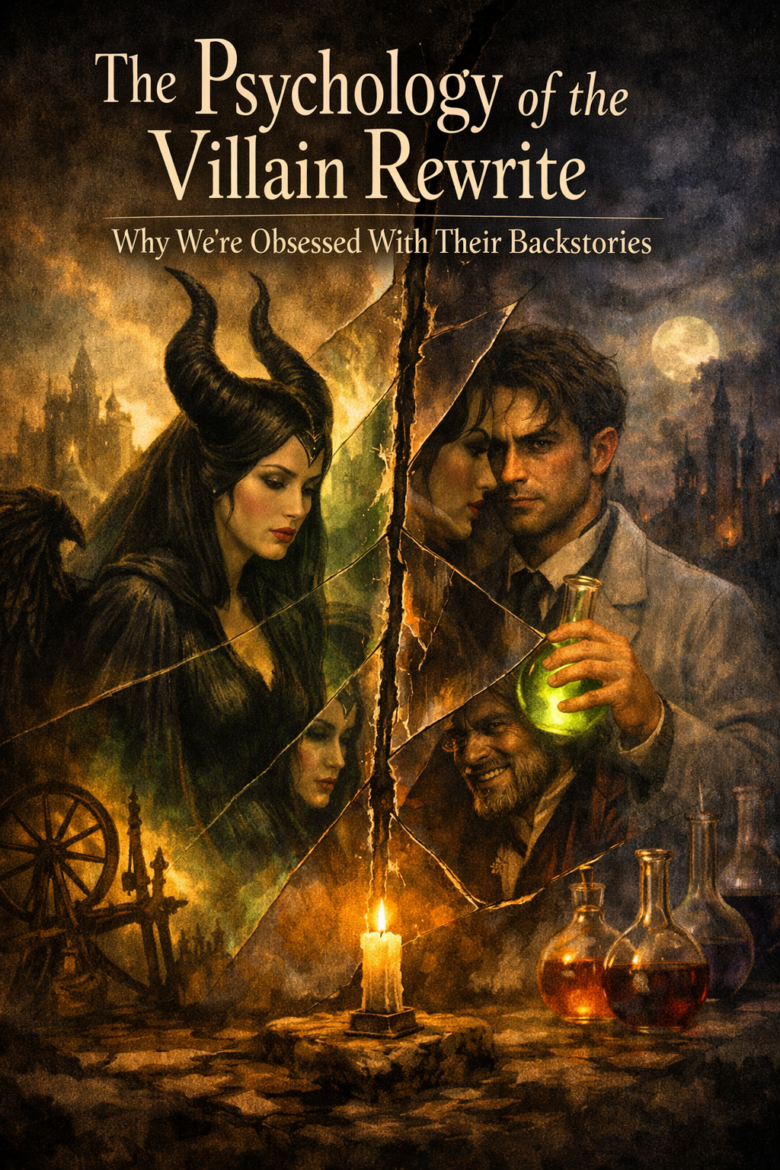
In 2014, Disney reimagined Sleeping Beauty by centering Maleficent’s backstory. She is a powerful fairy and, as a child, a friend to Stefan, who later becomes king. To claim the throne, Stefan betrays her by drugging her and cutting off her wings while she sleeps. In a heartbreaking scene played by Angelina Jolie, Maleficent screams in agony as she realizes what he has done.
The movie nudges the viewer to sympathize with Maleficent. We understand her anger because the story insists, implicitly: Look what happened to her.
How many times have you felt that way? How many times have we been misunderstood for our actions and watched others judge us without knowing the full story?
Enraged, Maleficent seeks revenge by cursing Stefan’s newborn daughter, Aurora. On her 16th birthday, Aurora will prick her finger on a spinning wheel and fall into a deep sleep that only true love’s kiss can break. Maleficent watches from a distance as Aurora grows up and, despite herself, comes to care for the child. She even regrets the curse and tries to undo it, but not even a prince’s kiss works.
This is the redeemed villain: proof that what feels monstrous can be softened and that people can be forgiven for their own uglier moments. In the film’s twist, Maleficent’s love — not romantic love — breaks the spell. It also disrupts the long tradition of men serving as fairy-tale saviors, but that’s a different article.
As the Joker tells Batman in The Killing Joke, “All it takes is one bad day to reduce the sanest man alive to lunacy.” He argues that anyone — even the strongest among us — can be pushed past their limits by a single catastrophic moment.
We’re drawn to villain backstories because they show what might be possible within ourselves. A bad situation, an accident, or grief — any of it can turn us into someone unrecognizable. As Robert Louis Stevenson wrote in Strange Case of Dr. Jekyll and Mr. Hyde, “I am not evil. I am no more evil than you. We are the same.” His words remind us that the boundary between virtue and vice is often a mirror’s reflection—thin, shifting, and disturbingly familiar.
For me, Grendel may have been the first “villain” I truly sympathized with. He commits vicious attacks on the mead hall for 12 years, devours men, and is described as a massive, horrifying monster. Yet Beowulf offers little background on why he attacks, beyond the idea that he cannot bear the sounds of singing and happiness.
We are left with bones, a vague explanation, and that gap has invited writers to take creative license. Some versions describe Grendel as a descendant of Cain, the Bible’s first murderer, part of a cursed line said to produce monstrous beings.
The 1999 film adaptation Beowulf, starring Anthony Hopkins, stays close to the poem’s basic setup: Hrothgar’s hall is terrorized, and Beowulf arrives to fight Grendel. Still, it shifts what the story is willing to explain. In the poem, Grendel’s “origin” is largely theological and symbolic. He is marked as an outcast, linked to “Cain’s kin” and paired with a mother who lives beyond the boundaries of human society.
The movie, by contrast, leans into horror and gives conflict more human texture. Grendel’s violence is framed less as a biblical curse and more as the behavior of a creature whose actions can be interpreted through motive and circumstance. Where the poem keeps him at a distance — a force defined by exile and condemnation — the film invites us to look for causes we recognize. That’s the modern “villain rewrite” impulse at work, even when the story doesn’t fully transform Grendel into a sympathetic protagonist.
For me, that opened the door to a realization: I had rarely considered the story from Grendel’s point of view. There’s a saying that the most dangerous person in the room is the one who has nothing to lose. That feels especially true for Grendel, living in exile, with the sounds of men singing causing him pain — and pushing him toward violence.
Not to mention, the songs are about him and not in a flattering way. Suddenly, we can see how merriment might feel like torment from the outside, and how resentment can take root.
In Robert Louis Stevenson’s Strange Case of Dr. Jekyll and Mr. Hyde, the doctor creates a potion to suppress his darker urges. It backfires, transforming him into Mr. Hyde — the amalgamation of his unacceptable impulses. Hyde is Dr. Jekyll’s unrestrained capacity for cruelty and vice. We can see ourselves in both characters; we recognize that, at different times, we have been both Jekyll and Hyde.
As readers and viewers, we’re a little like Maleficent: capable of change, pulled by conscience, still hoping for redemption. But maybe some of us don’t want to listen to the Dr. Jekyll inside. Maybe we want to let our own Mr. Hyde out.
REFERENCES
Maleficent: Before the sun sets on her sixteenth birthday… | Pop Verse. https://pop-verse.com/2014/06/03/maleficent-before-the-sun-sets-on-her-sixteenth-birthday/
Todd Philips | Bounding Into Comics. https://boundingintocomics.com/tag/todd-philips/