The attraction to gothic stories for me has always been their ability to transport me back into a world long gone, but some traces persist—the trendy “trad” or traditional wife with her nods to the 1950s prim-and-proper housewife. But there is something sinister behind that smile and the glint of her smart appliances; there’s a butter knife in her hand and a hatchet tucked in the back tie of her apron. She smiles to keep the peace, but for how long? When will this happy housewife snap and wipe out her entire family? She is an actress dissatisfied with her stage work and seeking a career change.
I used to believe that my love of architecture, antiques, and House of Worth gowns drew me into this era. What was the fascination of the Victorians’ repression of sexuality? Let’s be clear, though; the repression was intended for women in all cases, scenarios, and every part of every day and nightlife. The widowed Queen Victoria, who was said to have had a healthy sexual relationship with her husband, Prince Albert, was no longer able to enjoy bedroom bliss. Victoria inadvertently forced her people into a perpetual mourning of rigid class distinctions and tight-laced corsets.
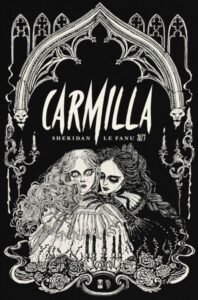
It is no wonder that the vampire, a nocturnal sexual demon, breaks through the stays of the wearer’s corset with its fangs not just to quench its thirst but to free the bound victim of their mortal cage. In Carmilla, Laura is confused by her romantic and intimate feelings for Carmilla, who is sweet, beautiful, and conservative in the presence of others, yet almost aggressive towards Laura. Laura exemplifies the divided self-trope. Laura is on the edge of falling into Carmilla’s trap. Had it not been for those around her, such as Madame De LaFontaine, she would have certainly succumbed – and I’m sad that she didn’t.
I also understand Madame De LaFontaine and where she comes from. As a mother, I would do everything I could to protect my daughter from disaster. Especially in the 19th century, a woman’s reputation was all she had, and it could be easily tarnished by gossip or misunderstanding. These women, such as LaFontaine, knew who the real monsters were, and it wasn’t Carmilla; it was the harshly judgmental society in which they lived as women who had no rights, and to me, it is more horrifying than any vampire or demon.
I wanted her to break from the conformity and dull routine of everyday life. Laura wasn’t even living until Carmilla arrived, so even an undead creature could promise more life to her than the living. Carmilla had been pining for Laura for years by appearing to her in dreams as a child, and she had always had an eye on Laura. If she had wanted to kill Laura, she had plenty of opportunities to do so. I don’t believe that Carmilla intended to end Laura’s life, but, in return, give her a new one. I wanted Laura to take a chance.
I’m always rooting for the supposed villain to succeed. I think we all are. This recent interest in the backstories of film villains reveals our collective curiosity about how monsters are created. Is it that we recognize ourselves in the villain, the demon, the beast?
Perhaps we are one rejection, disappointment, betrayal, or heartbreak away from our villainous origin story.
Carmilla lures them in with her damsel in distress trope when she is a femme fatale and has the fangs to prove it! Carmilla lays it on thick with her pale skin and apparent frailty. I won’t for one moment believe that Victorian women didn’t know what they were doing in playing these genteel roles of soft hyper femininity. I can assure you there is a plot and structure in the secret world of women. I’m reminded of a line from the 1998 film Elizabeth, in which Queen Elizabeth I addresses the clergy, urging them to unite as one Church of England, thereby severing their ties with Rome and, therefore, the Pope.
Clergyman1: Madam, by this Act — by this Act, you force us to relinquish our
Allegiance to the Holy Father.
Elizabeth:How can I force you, Your Grace? I am a woman. I have no desire to make
windows into men’s souls. I ask, can any man, in truth, serve two masters and be faithful to both?
Carmilla’s mother and Elizabeth knew how to play the game. Women had to be highly skilled to appear guileless and unassuming. Carmilla’s mother (or whoever she was) knew that she could pull on the strings of masculinity in its need always to save women to get what she wanted – another setup, another victim. She has split the damsel in distress in two, dividing the being into capable and incapable.
Although Carmilla is beautiful, it is a façade. She is the opposite of the Keats-inspired “beautiful lady” painting, in which the woman, fairy, or goddess always occupies a position atop a horse or a man in a daze at her beauty. When she is not on top, she is still in a powerful position, pulling the poor knight down to her to overthrow him. The men in these paintings
They are helpless and no match for the deadly woman’s feminine prowess. It is the Eve effect, the stereotype and excuse that Victorian men use to justify their scandalous behavior.
Conversely, the Victorian woman falls victim to the same temptation but is made a social pariah. In Carmilla, many undertones of lesbianism and homosexuality pose a threat to Laura’s trajectory of becoming a proper wife and ultimate mother. Hyper-femininity in the cult of domesticity is a way of saying that women have no other desire than to obey their husbands, keep the house, and have babies. Women of the 19th century are often presented as fragile, docile, and one degree above children in intelligence, falsely portraying women as having only one desire, and that is to be maternal and pleasing to men.
But what if your husband dies and never comes home? In Hawthorne’s The Wives of the Dead, the reader isn’t sure that the sisters’ husbands are dead or that even the sisters are (sisters-in-law) and not just one woman. I find it interesting that, although men of the 19th century enjoyed far more freedom than women, they still felt the need to create Dr. Jekyll and Mr. Hyde, when that is precisely what men in the Victorian age lived: one clean life by day and a dark secret life at night. They were/are the rule makers. Did they need this story? Men of the Victorian era had the means and the permission to be both Jekyll and Hyde without fear of ostracism or exclusion from society.
My interpretation is that the sisters are not sisters at all; instead, they are one. The concept of a divided self, often referred to as a split personality, is more evident in women in Gothic tales. It is more apparent (to me, as a woman) that the stories indirectly display women’s multifaceted characteristics. They couldn’t say aloud or even write how they felt, so it’s cool that a man could see a woman in her true nature.
The story of the sisters, the widowed wives, demonstrates Hawthorne’s ability to regard women as beings rather than merely as reproductive organs. That this woman, this woman, is fantasizing about a life of “what if,” what if my husband is dead? What if he is alive? I think there is a real sense of guilt between these two sisters: the guilt of joy at the husband’s passing, the excitement of an old lover showing up to let her know she still has that “it.”
The other self is saddened and afraid of life without a caretaker, knowing she will soon have to find another man to feel secure. What would be the alternative to being widowed if your husband died a poor man? Would women end up at The Harlot’s House? Wilde’s story of a couple passing by a brothel is creepy and fascinating. Why was it so easy for the woman to be lured into this brothel? Is this the perception that women are easily fooled? Or was she so suppressed that this dancing and singing of spirits piqued her hidden carnal desires?
There is a euphoric, almost drug-like inducement that attracts the woman to the deadly delights of the brothel. Why does it not affect the man the same way, and why doesn’t he go in after her to save her? Is he afraid that she wouldn’t want to be saved? Or that once she has crossed the threshold of a house of ill repute, she has shamed herself in such a way, according to Victorian morality, that he can no longer associate himself with her? She is a lost cause. What I enjoy most about these stories is that there is so much left to interpretation, allowing the reader to take the story in any direction they choose.
In The Turn of the Screw, we again have a young woman who seems starved for affection and love, someone who has been sheltered and has little experience of the world, and who is immediately taken in by a handsome single man with a proposal that most people would’ve rejected. The reader never really knows if the Governess is seeing ghosts or if this is just a result of her pinned-up sexuality. Peter Quint’s character is portrayed as some lothario or
Incubus, implying that he is inappropriate with the children. However, we did not receive a specific response from Miles regarding the nature of the impropriety.
This lack of explanation for what happened to the children and whether the Governess is seeing dead people is what makes the story so terrifying. In one of our previous class discussions, the question was asked: Is it scarier not to know? Absolutely! It stems from our childhood fear of the dark. We can imagine all sorts of monsters in the black void.
We don’t know what lies in the darkness or how deep it goes. So, not knowing is terrifying. Although fictional, this story is based on a real-life account told to James by Edward White Benson, then Archbishop of Canterbury. This tidbit of information lends living flesh to the story for me, as there is some version of its truth. The scene in which the Governess is walking around the garden daydreaming about how romantic it would be to see the Master as she turns the corner, but what she sees is the ghost or the apparition of Peter Quint.
We know that Peter and Ms. Jessel exist and still do, but the Governess seems to be the only one who can see them; otherwise, everyone else is making her feel delusional and pretending that they don’t see them. Peter and Ms. Jessel can also be viewed as the Governess’s side that is trapped and repressed. One of my favorite lines in the story is when the Governess tells Mrs.
Grose said that she’d rather see Miss Jessell than not.
This point leads me to O’Brien’s “What Was It?” The invisible monster. In this story, the beast is visible yet invisible. When the blanket is placed over the monster, its grotesque form becomes apparent. But I wonder if the men have preferred to see the beast. I would not have wanted to see it, but, as the Governess notes in The Turn of the Screw, the issue is not seeing.
Miss Jessel/monster/ whatever. Ghosts, or the possibility of ghosts, can elicit intense paranoia. I couldn’t stop thinking about how this story would fit perfectly into a Black Mirror, Tales from the Darkside, Tales from the Crypt, or a Twilight Zone episode.
Any unexplained noise in a house at night can be a ghost. Alternatively, the skeptic can argue that the noise is due to the house’s age. Something crawls around in the attic at night; I can hear the monster scratching the walls. Again, the skeptic explains that you have rats. Can all paranormal activity be reasoned away? In O’Brien’s story, as a reader, I immediately think that these men are having a “narcotic dream,” and these hallucinations are opium induced.
However, others outside the two men also observed the moving object beneath the sheet. Or maybe those other people in the story are also hallucinating. Ambiguity and mystery go hand in hand in Victorian-era literature. Modern writing exposes too much of the monster, revealing too much of what makes the monsters terrifying. While the creature continues to squirm under the blanket, it can be anything our minds can conjure up.
In one of our first modules under the “History of All Things, “Gothic,” there’s a list of TV shows and movies, most of which I have already seen. But I’m so glad they were brought up because I’ve wanted to talk about these shows. I loved Penny Dreadful and the character Vanessa Ives, who epitomizes several gothic tropes we have discussed: the Damsel in Distress, the Femme Fatale, Madness, and the Divided Self, set against Victorian morality and the rebellion against societal constraints.
It was one of the first shows that impressed me by combining all the Victorian-era Gothic stories into a single series and weaving them into a cohesive narrative. Since then, we have watched several other series that tie lore and historical fiction into movies and series. In Penny
Dreadful, Vanessa is associated with Dr. Frankenstein, his monster, Dorian Gray, a werewolf, Mina Harker, and Van Helsing in the pursuit of Dracula. The show is exceptionally well done. These Penny Dreadfuls were 19th-century crime stories sold for a penny apiece. Although Penny Dreadful is no longer popular, the True Crime podcast is. Alongside true crime podcasts and series, there has been a rise in ghost story podcasts that present themselves as accurate accounts, but they are fictional.
I enjoy them all, nonetheless.