The Past in the Future.
Indeed, the most trivial of past episodes we forget, but then there are the memories where we can still feel the scrape of our knees slamming against the pavement, the grittiness of gravel and powdered bits of broken concrete as if it were happening right now, on repeat, in a hellish loop of déjà vu.
I have been here before.
This is how I felt buying ballet tights for my daughter, who had torn through the first pair with the ease and calmness of someone who doesn’t have to pay for them. It didn’t matter that I had to drive to Montrose, pick them up, leave early, and sit in rush hour traffic for 45 minutes; I would buy the tights no matter what. The tights were specific in that they had to be from a certain brand and a particular shade of pink – theatrical pink, to be exact.
Little Shop of … Memories?
The dance company told me there was only one place I could go. A little dance-wear shop in the historic Montrose area of Houston, affectionately known as the “gayborhood,” with its rainbow-painted streets and brightly colored pride flags hanging from bars and artists shops. This little dance shop was once a house one hundred and fourteen years ago. I stood inside its small one-time living area, careful not to step too hard on the old wooden floors, which cracked and groaned with every step. I imagined the upper-class family that once lived here with their stiff collars, corsets, and lace parasols.
What used to be a fireplace and hearth, the entertainment center for the entire family where stories, announcements, and celebrations were held, is now a spot for bejeweled ballet bags encrusted with colorful plastic diamonds to hang on a shiny gold rotating rack. A glass case displays ballet accessories, including toe pads, ribbons, elastics, and autographed pointe shoes of former prima ballerinas. The case also features vintage ballet shoes and handmade tutus, accompanied by an antique cash register displayed solely for show and inoperable.
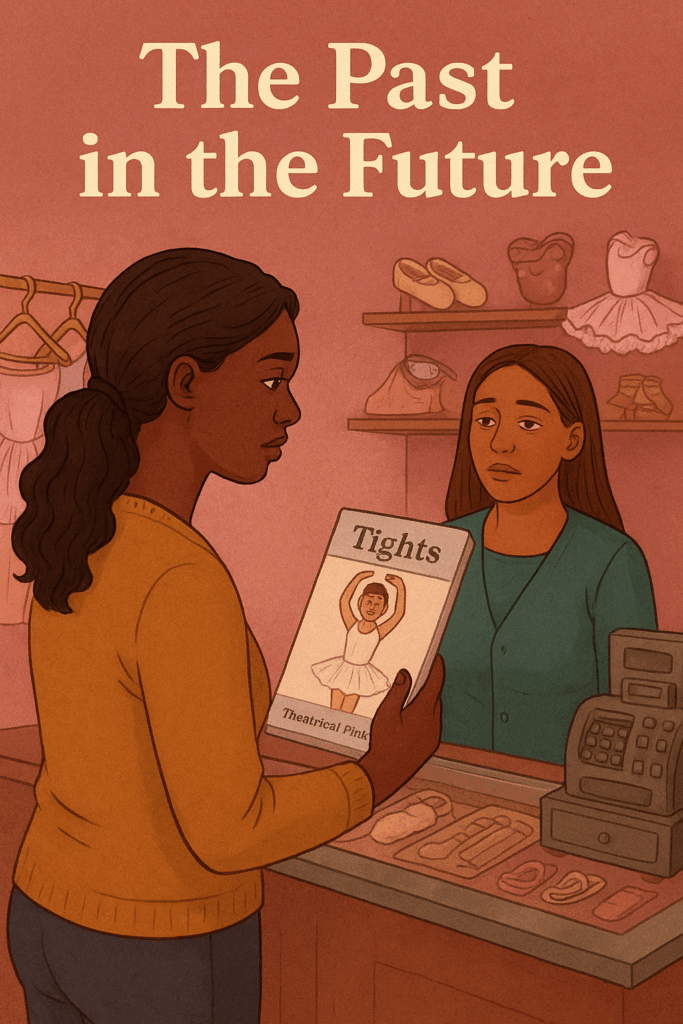
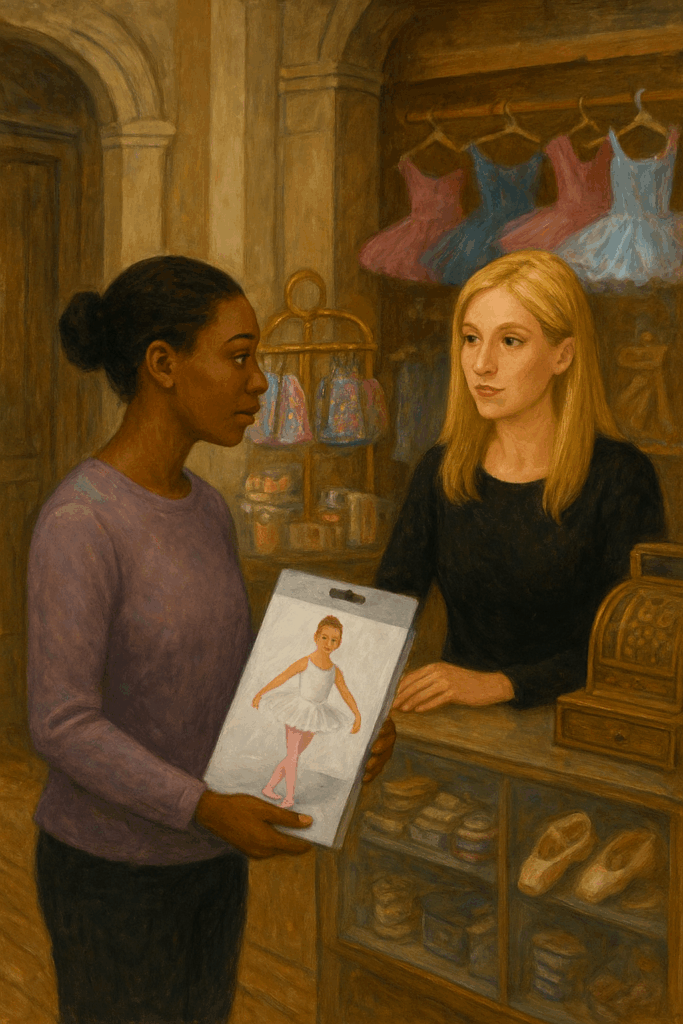
A tall, blonde, slender woman stood behind the register, who seemed to have been trying to get my attention for longer than she’d have liked.
“Ma’am, how can I assist you?”
” I need um –“
“Oh, you’re the one who called!” Eyes rolled up toward the ceiling.
“Yes, the tights, umm, theatr–“
“Theatrical Pink, right, yes, yes.” She speaks.
Almost without looking, the lady pulls the package of tights from behind the glass counter. The package is white and grey with a child model on the front. The little prima ballerina is smiling, her hair up in a bun, her arms over her head, her feet in first position, and her tutu is plush and white. She is perfect, the dream of all dance moms who strive and stress to get their daughters to class with perfectly glossed buns, clean leotards, and tights without holes.
“Ma’am, did you want them?” She says exhaustively.
I hadn’t noticed that I was lovingly stroking the edges of the package or that the little ballerina entranced my eyes. I wonder how long the woman had been saying ma’am or how long I’d been standing there.
“I’m sorry,” I said, shaking my head. “It’s been a long day.”
While driving home, I recall my first— and last—ballet recital.
Retrospection …
I was eight years old and at the awkward stage of body hair – hair under my arms and other confusing places, thick glasses, and fuzzy, never-quite-combed, sandy brown hair.
My father gets off work, his collar is open, and his uniform is stained. Riding in his pickup truck, you can smell alcohol and stale cigarette smoke in the air. The tears are weighing down the bottom lids of my eyes, and my mouth refuses to open.
We are late.
I am late.
I am late to my first ballet recital and still do not have tights. My mother is of no assistance and insists that I close her door with myself on the other side.
As a result, my father ended up stopping at the nearest convenience store. When he comes back, he hands me a pack of pantyhose — hot pink pantyhose, not theatrical pink ballet tights, but hooker hot pink pantyhose.
The tears that were weighing down my lower lids have all but burst onto my cheeks like a levee breaking open and flooding my face and neck.
Yes, this is happening.
Dance like no one’s watching …
My instructor, Miss Bunny (yes, this is her real name), is sweet and reassuring, and I can sense her empathy. She looks back at the other girls who are uniformed and in line, waiting to hit the stage, and then she looks back at me, back to the girls, and then back to me again. Ms. Bunny lets out a deep sigh, kneels to my level, and grabs my shoulders.
“It will be alright, sweetie. No one will even notice. I promise.”
Her voice quivers as she says this, and a glossy glint of sweat begins to shine at the top of her forehead. Even at 8 years old, I can tell she’s worried, petrified even.
On with the show …
Due to my unforeseen wardrobe malfunctions, Ms. Bunny positioned me at the back, the last ballerina in line, for obvious reasons. The other ballerinas won’t look at me, but they snicker and giggle under their breath.
While we each placed our hands on the girl’s hips before us and walked out onto the stage, I was paralyzed with fear. I can’t seem to move once the music starts, so I don’t; I freeze. My eyes are fixed on my father and brother, who are seated close enough that I can see them. My brother is chuckling, and my father seems uneasy and anxious to get this mess over.
I wonder now what he must’ve thought seeing me up there on the stage in hot pink hooker tights, hairy armpits, messy hair, and thick glasses? I wonder if he felt the same shame I did. Was he embarrassed, too?
Miss Bunny said no one would notice, but they did. Everyone did.
The Calm after the Storm …
Most noteworthy was my lack of tears on the ride home. There was a kind of silence so loud you could barely move. I stared at the night, watching the sleek, wet street fly underneath us. My father tried his best to apologize.
“I just didn’t know what to get you, pumpkin. I didn’t know.”
“It’s ok, Daddy,” I say, feeling bad for him that he feels terrible for me; this would be the last time I would ever feel sympathy or anything for my father.
Mother’s door is still closed when we come back home. Didn’t she know the world had just ended? I remember staring at it as if it would open and a woman and a little ballerina would come out, the perfect ballerina, with the perfect bun, hairless armpits, and theatrical pink tights. This woman is proud of the little ballerina she spins around and kisses on the cheek.
Mother’s door never opens.
Teeter Toddler
At the daycare, I was almost knocked down by my daughter at the door.
“Mommy! Mommy!” she says, screeching and jumping with sticky blue candy residue all over her face.
“Hey, Love Bug. How was your day?” I say, smiling, as I open the car door.
“Where are we going, Mommy?”
“We’re going home, baby. I have something for you.”
“What is it? Is it a LOL Surprise doll? Is it a Shopkin? “
Let it go …
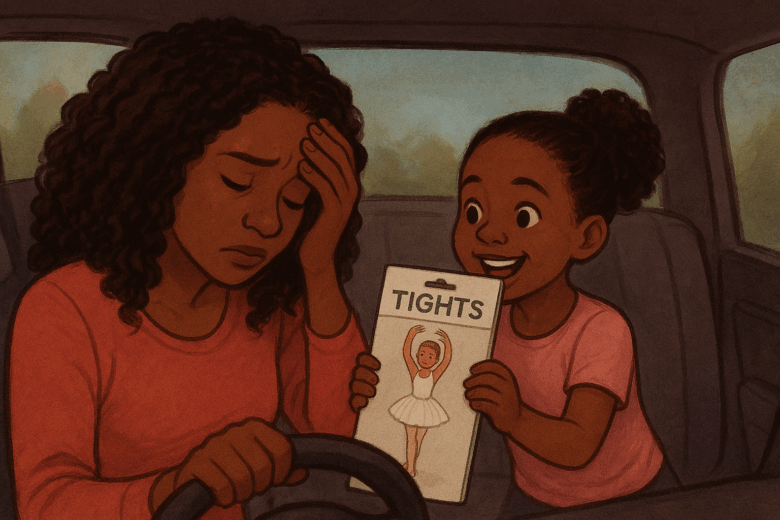
I reach into my purse to pull out the tights, and to my shock and horror, I discover they’re not there. They must be here! Where are they? As I dig and dig, I am close to tears. Where are they?!Where are they?!In my panic, my face falls into my hands and onto the steering wheel while my child, unbuckled in the back seat, hums a “Kidz Bop” ditty to herself.
Planting a big sticky kiss on my cheek, my daughter says, “Mommy, you bought new ballet tights? Thanks!”
She hands me the package of tights with the little prima ballerina on the front. I hold the package close to my chest, staring out the window in silence.
“So, what did you get me, Mommy? — Mommy? “
Braided Narrative Structural Outline
I. Introduction
The introduction opens with a bold title, The Past in the Future, hinting at how the past can feel as real as the present, setting the reader up to expect different storylines over time.
1st Thread: Introduces the main point of the story, the ballet tights, and how they are a trigger to the past for the main character/narrative.
2nd Thread: The pink ballet tights must be specific, not just any kind, but “theatrical pink.”
3rd Thread: Establishes that the main character is a mother determined to buy the correct tights for reasons the reader won’t know until later in the story, intertwining the 1st, 2nd, and 3rd threads into one.
II. Body Paragraph 1: Little Shop of … Memories?
The mother is now at the ballet shop, reminiscing on her first ballet performance. The shop, converted from an old home built at the turn of the century, symbolizes the past being brought into the present.
Body Paragraph 2: While in the shop, the mother is fascinated with the appearance of the package of tights with a child model who appears to be the perfect prima ballerina, everything she never was and everything she hopes her daughter will be: perfect hair and clean leotards.
Body Paragraph 3: After leaving the dance shop, the mother is, in retrospection, driving home. Here is where the other two braids come together, explaining why the mother needed specific tights for her daughter and why they are so important. The mother has had her own traumatic experience as a child during her first recital, where the father is neglectful by buying her the wrong-colored tights, not theatrical pink as she needed, but hot pink. The child is made to dance in these tights, humiliating her, which has left a scar that has remained until adulthood.
V. Conclusion: Let it go
After picking up her daughter from daycare, she discovers she can’t find the ballet tights she purchased from the dance shop. She thinks maybe she has left them there. While panicking, her daughter hands her tights from the car’s back seat, oblivious to her mother’s stress. The child is more concerned about whether her mother bought her a new toy and doesn’t know the significance of the tights. This final part weaves all the braids together. The mother is redeeming her childhood by ensuring her daughter has what she needs so that she never feels neglected like she was. Buying the correct tights is more than just the mother’s responsibility; it also reflects how the mother loves the child and will never neglect her.
Reflective Essay
I chose the Braided Narrative Structure because I like the idea of weaving a story together like a braid, three parts into one. With the braided narrative structure, you can add different storylines into one. You can add the past, the present, and the future. I think it works best for stories that go into the past but end the story with a sort of completion of the original problem or theme. I broke the braid by starting different periods with bold titles explaining where we were in the story. The braided structure is excellent when incorporating memories into a story.
Memories can be challenging to add to stories, just like dream scenes. Still, the braided narrative makes it very convenient because you can visualize the braid symbolizing each story you want to incorporate. Picturing the braid was just like a plug-in method for me if that makes sense—the braid guides the writer into where certain parts of the story should be added. The first braid represents the past, the second braid represents the present, and the third braid represents the future, which can be used to conclude what the writer hopes will happen.
I’m always grateful for the workshopping and the feedback I receive. My classmates brought up some ways I can improve my writing grammatically and structurally. Workshops have benefited me, even though I sometimes fear being judged for my writing. As I have progressed in this graduate program, I have become more and more comfortable with classmates reading my work, and I now begin to look forward to what my peers say. I know their opinion is only to help me become a better writer, so I am never offended when given feedback I might not necessarily agree with. Workshopping has become a gratifying part of my graduate experience.